
In aerospace cabin seating architecture, even minor hardware components such as locking pins, latch assemblies, and structural chassis brackets are required to withstand mandatory dynamic testing under 16G crash load conditions. Achieving compliance demands full lot-traceability, mill material certifications, and closed-loop process controls. These stringent regulatory requirements make consistent, precision manufacturing far more critical than design complexity itself.
When engineering, sourcing, or maintaining commercial aircraft seating systems, structural integrity and cabin reliability depend heavily on a complex array of precision metal hardware. While macro-level components like mechanical recline cylinders control motion, it is the smaller, high-strength aircraft seat hardware—the hinges, support brackets, quick-release pins, and locking latches—that absorb critical mechanical load paths.
For aerospace procurement managers, engineering teams, and Original Equipment Manufacturers (OEMs), sourcing certified contract hardware components from FSD in China is a proven strategy to optimize Total Cost of Ownership (TCO) and mitigate lead-time risks. As outlined in our comprehensive aircraft seating resources, every individual accessory must match strict engineering benchmarks to safeguard passenger safety and line maintenance efficiency.
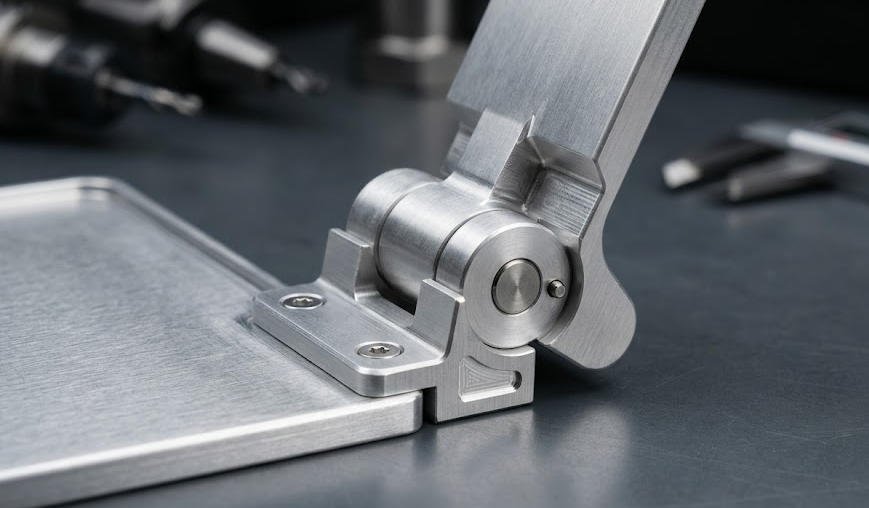
1. Thin-Wall & High-Cycle Motion Mechanisms: Meal Trays & Armrests
In-cabin motion mechanisms endure hundreds of thousands of duty cycles from passenger interaction. The primary technical challenge when manufacturing high-wear hardware, such as Meal Tray Hinges (P/N: 869573-417) or Table Leaves / Fold Pages (P/N: 1005375-711, 1002689-001), is controlling material warp and residual stress distribution during production.
Because these components feature thin-walled geometry and require multi-axis CNC milling or multi-stage stamping, internal material stresses can easily induce micro-twisting or bowing. FSD utilizes custom-designed cryogenic aging fixtures and multi-stage milling paths to isolate and eliminate stress propagation. This helps control structural flatness so meal tray mechanisms can be reviewed for smooth deployment without sagging, rattling or binding after project-specific validation.
Thin-wall multi-axis milling plans can include surface finish targets such as Ra 0.8 when the drawing, material and inspection requirements support that target.
2. Micro-Tolerance Locking Hardware: Pins, Latches & Travel Stoppers
High-wear locking hardware secures the position of seat shells, recline angles, and modular perimeter assemblies. Components like Lock Pins (P/N: 1003107-001, 137-00-409-09) and heavy-duty Latches (P/N: SAM222-18, SAM300-2) dictate both passenger safety and the velocity of routine line maintenance.
- Dimensional Tolerance Controls: For quick-release alignment pins and fastening pins, we utilize centerless grinding to hold external diameter tolerances within a strict ±0.005mm range. This ensures a flawless slip-fit mechanism that eliminates binding under mechanical load.
- Surface Engineering & Anti-Galling: For high-repetition wear components such as Mechanical Travel Stoppers (P/N: 216069-5 to 216069-13 Series, 52172), raw machining is insufficient. FSD applies specialized hard anodizing (per MIL-A-8625) or chemical passivation to eliminate surface pitting, galvanic corrosion, and material fatigue.
By implementing a strict salt spray testing protocol (up to 96 hours per ASTM B117), our hardware components exhibit zero electrochemical corrosion risk when paired with dissimilar structural alloys or exposed to aggressive airline-cabin disinfectants.
3. Primary Load Path Engineering: Support Brackets & Track Fittings
Structural metal components form the primary load path from the passenger seat assembly directly into the aircraft floor tracks. Heavy load-bearing elements, including structural Support Brackets (P/N: D2557206221800, 453A1810-6) and cabin Floor Track Inserts/Fittings (P/N: T303A330), must maximize strength-to-weight ratios to survive extreme stress vectors.
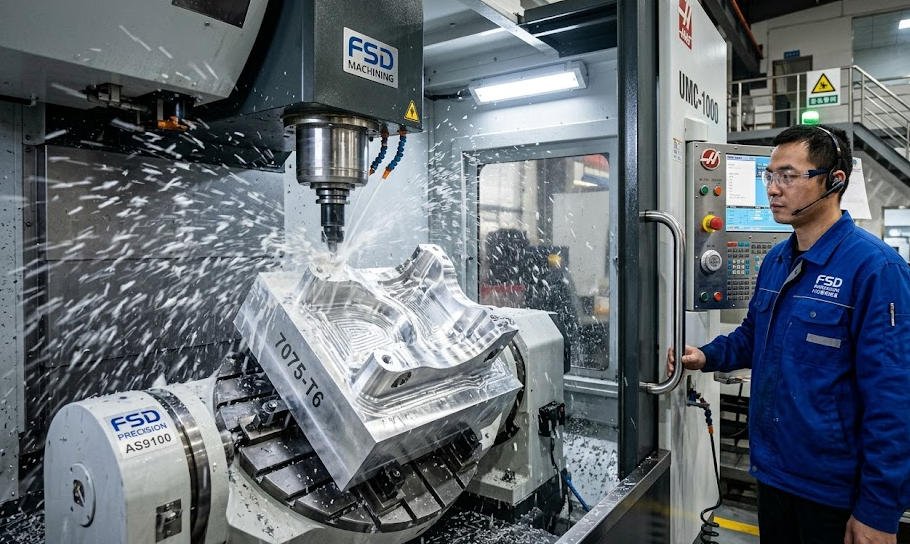
To eliminate the risks of hidden internal voids, porosity, or micro-cracking inherent in cast alternatives, FSD mills these structural brackets entirely from solid blocks of certified aerospace-grade raw materials, such as Aluminum Alloy 7075-T6 or 6061-T6. Every manufacturing batch we deliver is accompanied by fully traceable Material Test Reports (MTR) confirming exact chemical compositions and mechanical stress profiles.
4. Closed-Loop Manufacturing Architecture: From Raw Stock to Airworthiness
To transform commercial-grade metals into flight-ready cabin components, our manufacturing facilities enforce a strict Closed-Loop Protocol. This engineering architecture represents FSD’s commitment to absolute consistency, ensuring that your parts meet structural compliance from the initial prototype to full-rate production:
- Design & DFM Validation: Complete interpretation of 2D/3D CAD (.STEP, .IGS, .PDF) blueprints to optimize tool paths, minimize component weight, and cross-verify tolerance stack-ups.
- Precision Machining (CNC & Stamping): Multi-axis CNC milling, turning, and multi-stage progressive stamping utilizing dedicated fixtures to isolate structural residual stresses.
- Controlled Heat Treatment: Process-monitored thermal hardening to unlock the maximum mechanical and tensile strength profiles required for high-stress aerospace applications.
- Surface Modification: Specialized aerospace coatings (Hard Anodizing per MIL-A-8625, Chemical Passivation, Electroplating) ensuring extreme anti-galling and anti-corrosion properties.
- Metrology & Inspection: Comprehensive dimensional inspection utilizing Coordinate Measuring Machines (CMM), optical comparators, and non-destructive testing (NDT) to verify micro-tolerances.
- Full Batch Traceability: Every shipment is locked to a definitive quality log, complete with First Article Inspection (FAI) reports and Material Test Reports (MTR).
5. OEM Sub-Assembly Integration: Minimizing Your Supply Chain TCO
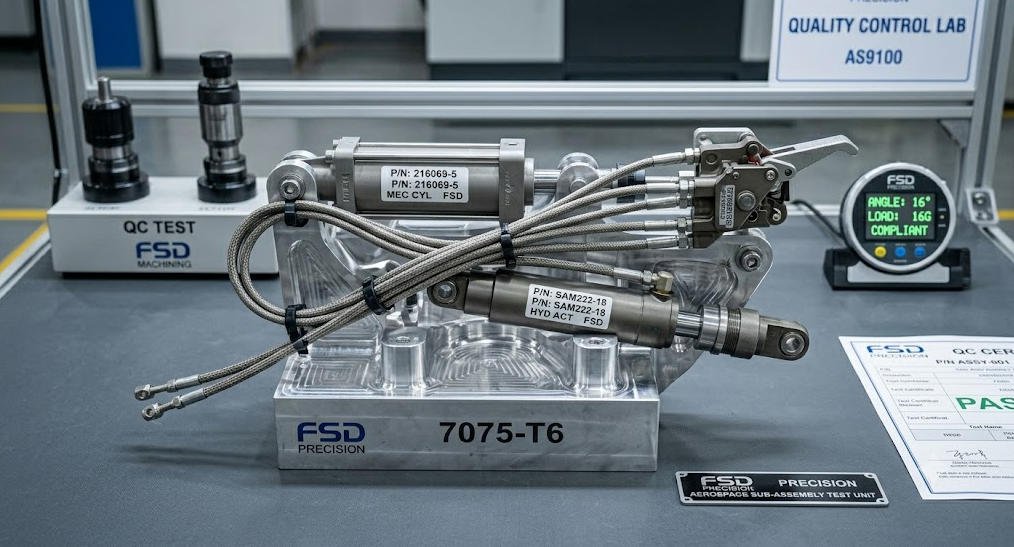
Modern aerospace procurement strategies are shifting away from sourcing loose, single-component hardware. To optimize your Total Cost of Ownership (TCO) and streamline your Incoming Quality Control (IQC), FSD offers complete vertical sub-assembly integration.
We possess the in-house technical capability to seamlessly assemble our precision metal hardware with custom aerospace seating control cables and high-precision seat actuator cylinders. By delivering fully tested, modular drop-in motion sub-systems directly to your production line, we help you eliminate multi-vendor coordination delays and reduce assembly cycle times by up to 35%.
6. Technical Cross-Reference for Aerospace Procurement Managers
| Component Category | OEM Reference Part Numbers / Series | Core Manufacturing Process |
| Meal Tray Hinges / Fold Pages | P/N 869573-417, 1005375-711, 1002689-001 | Thin-wall Multi-axis CNC Milling & Precision Level Stamping. |
| Heavy-Duty Latches / Locks | P/N SAM222-18, SAM300-2, 215063-25 | Progressive Stamping, Precision Riveting & Assembly. |
| Precision Pins / Axles | P/N 1003107-001, 137-00-409-09, F0526600 | Centerless Grinding (Diameter Tolerance to ±0.005mm). |
| Chassis Brackets / Support Bases | P/N D2557206221800, 453A1810-6 | Solid-Block 5-Axis CNC Milling (7075-T6). |
| Mechanical Travel Stoppers | P/N 216069-5 to 216069-13 Series, 52172 | High-Repetition Impact Milling & Thermal Hardening. |
| Track Fittings / Bushings | P/N T303A330, STRATIVER2882, 139-00-503-05 | Heavy-duty Precision Turning & Passivation. |
🔍 Supported Engineering Specifications & Sourcing Scope
To streamline your technical review, our production facility provides build-to-print contract manufacturing matching the following specialized aerospace component categories:
- Aircraft Seat Brackets: Precision 5-axis milled titanium and high-strength aluminum chassis supports designed for 16G structural compliance.
- Aircraft Seat Locking Pins: Centerless ground, micro-tolerance quick-release pins and alignment hardware.
- Aircraft Seat Latch Mechanisms: High-repetition, progressive stamped locking latch components and wear-resistant sub-assemblies.
- Aircraft Seat Structural Fittings: Flight-ready cabin floor track inserts, seat clips, and heavy-duty tie-downs.
- Aerospace Seat CNC Machined Parts: Flexible, high-mix low-volume (HMLV) precision milling for complex geometries and retrofit projects.
Frequently Asked Questions
- Q1: Can FSD manufacture custom aircraft seat hardware based on original OEM part numbers?
- A1: Yes. We provide precise contract manufacturing and specification matching based on your original OEM reference part numbers, engineering drawings, or physical benchmark samples.
- Q2: How do you support structural seating component requirements related to dynamic load or crash-test programs?
- A2: We review machining route, material selection, geometry and inspection requirements around the buyer drawing and qualification process. Final test performance must be confirmed through the customer required validation program.
- Q3: What are your capabilities regarding Low-Volume, High-Mix (LVHM) aerospace orders?
- A3: We specialize in flexible production runs tailored for cabin retrofits and maintenance cycles, providing comprehensive Design for Manufacturability (DFM) reviews to optimize lead times and total cost of ownership (TCO) without requiring mass-production tooling.
📋 Streamline Your Aerospace Supply Chain Today
All RFQ requests are reviewed by FSD’s core aerospace engineering team, including comprehensive manufacturability analysis, tolerance feasibility checks, and raw material selection validation.
Are you struggling with long OEM lead times, uncompetitive multi-vendor pricing, or strict 16G compliance audits?
- [ 👉 Click Here to Upload Your 2D/3D Drawings (.STEP/.IGS/.PDF) ]
- [ 👉 Click Here to Submit Your OEM Part Number List ]
Our engineering department will conduct a complete Design for Manufacturability (DFM) assessment and provide a technical quotation within 24 hours.
Need help sourcing custom OEM parts?
Send drawings, samples, part numbers, material requirements, quantity, and application details for engineering review.