
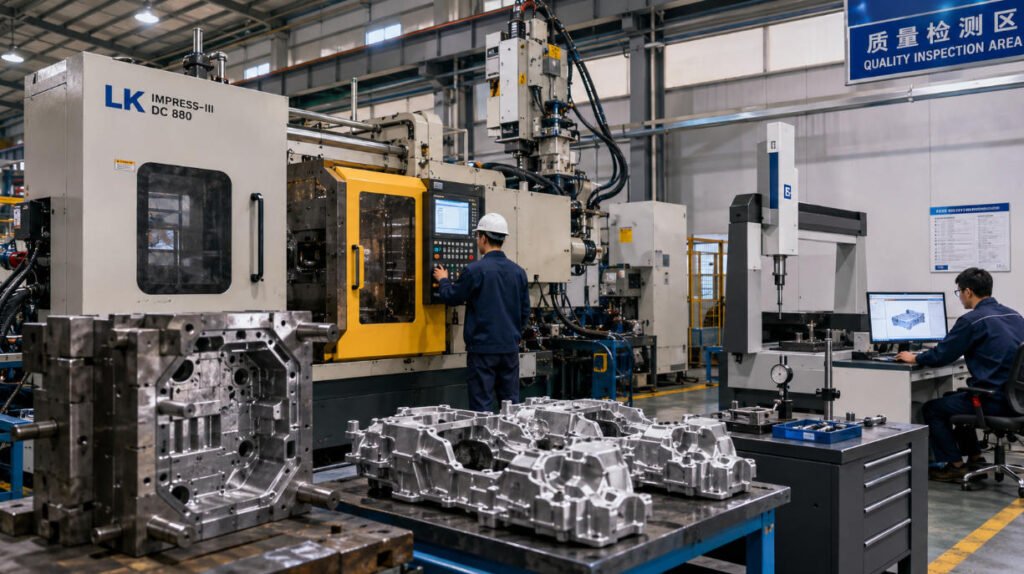
Die casting is a high-pressure metal manufacturing process that injects molten metal into a reusable steel mold, also known as a die, to produce accurate and repeatable metal components.
It is commonly used for OEM parts that require:
- High production efficiency
- Consistent quality
- Complex geometries
- Good surface finishes
- Stable dimensional performance
Common die casting materials include aluminum, zinc and magnesium alloys.
Compared with CNC machining, die casting is usually more suitable for medium and high-volume production because the tooling investment can be distributed across a large number of parts.
However, die casting is not the best choice for every project. Production volume, part structure, material requirements, tolerance needs and post-processing requirements should all be evaluated before selecting the manufacturing process.
FSD Precision helps OEM customers evaluate complete manufacturing solutions, including die casting, CNC post-machining, surface finishing and inspection.
What Is Die Casting?
Die casting is a metal casting process that uses high pressure to force molten metal into a precision-machined steel mold.
The mold contains the shape of the final component. After the metal fills the cavity and cools, the finished casting is removed and prepared for additional operations if required.
A typical die casting process includes:
- Die design and tooling
- Mold preparation
- Metal melting
- High-pressure injection
- Cooling and solidification
- Trimming
- Secondary machining and finishing
Because the same mold can produce many parts, die casting is widely used for repeat production programs.
How Does the Die Casting Process Work?
1. Die Design and DFM Review
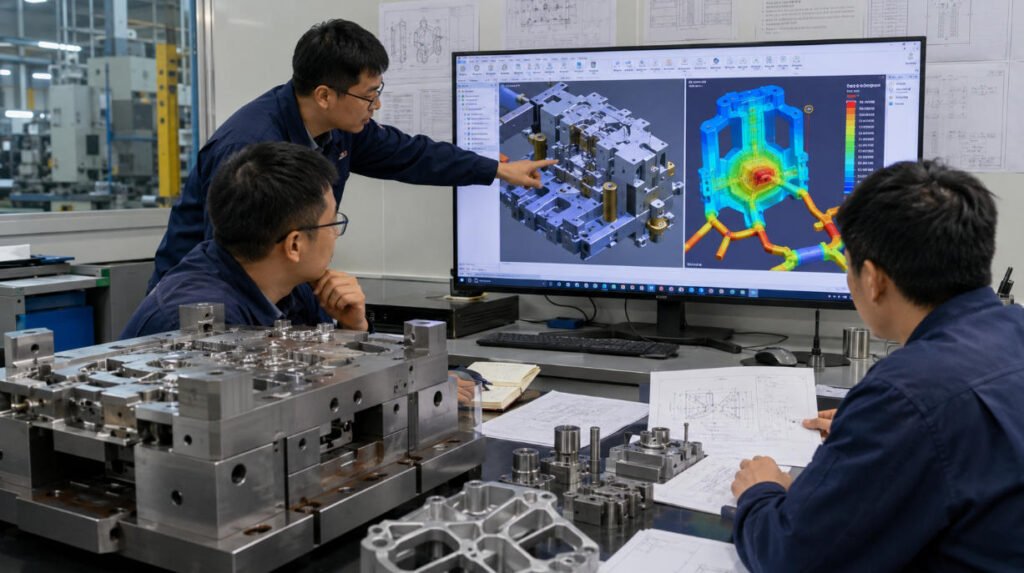
Before manufacturing the mold, engineers review the part design to ensure it is suitable for casting.
Important factors include:
- Wall thickness
- Draft angles
- Parting lines
- Metal flow direction
- Cooling requirements
A proper DFM review helps reduce risks such as:
- Porosity
- Cold shuts
- Incomplete filling
- Uneven shrinkage
Early design evaluation can reduce tooling modifications and improve production stability.
2. Metal Melting and Injection
The selected alloy is melted to the required temperature.
During casting, hydraulic pressure pushes molten metal into the mold cavity at high speed.
This allows the material to fill:
- Thin walls
- Detailed features
- Complex shapes
- Internal structures
Proper control of injection parameters helps achieve consistent casting quality.
3. Cooling and Ejection
After filling, the molten metal cools and solidifies inside the steel mold.
The mold then opens and ejector systems remove the finished casting.
After ejection, parts may require:
- Trimming
- Deburring
- CNC machining
- Surface finishing
4. CNC Post-Machining and Finishing
Many die cast parts are produced close to the final shape, but some functional areas require additional machining.
Common secondary operations include:
- Precision holes
- Threaded features
- Assembly surfaces
- Tight tolerance areas
FSD Precision combines die casting with CNC machining services when additional precision is required.
Hot Chamber vs Cold Chamber Die Casting
The choice between hot chamber and cold chamber die casting depends mainly on the alloy characteristics.
Hot Chamber Die Casting
Hot chamber die casting is commonly used for lower melting point metals such as zinc alloys.
Advantages:
- Fast production cycles
- Efficient repeat production
- Suitable for small detailed components
Applications:
- Hardware parts
- Connectors
- Small mechanical components
Cold Chamber Die Casting
Cold chamber die casting is commonly used for aluminum and magnesium alloys.
The metal is melted separately before being injected into the mold.
Advantages:
- Suitable for higher melting point alloys
- Supports larger structural components
- Widely used for aluminum die casting
Applications:
- Automotive components
- Industrial housings
- Equipment parts
Common Die Casting Materials
Material selection affects:
- Strength
- Weight
- Corrosion resistance
- Surface appearance
- Manufacturing cost
| Material | Key Characteristics | Applications |
|---|---|---|
| Aluminum Die Casting | Lightweight, strong, corrosion resistant | Housings, brackets, industrial parts |
| Zinc Die Casting | Excellent detail, good surface finish, dimensional stability | Connectors, hardware, precision small parts |
| Magnesium Die Casting | Lightweight with high strength-to-weight ratio | Electronics and automotive components |
Aluminum Die Casting
Aluminum is one of the most widely used die casting materials.
Advantages:
- Lightweight
- Good strength-to-weight ratio
- Good thermal performance
- Corrosion resistance
Common applications:
- Electronic housings
- Motor components
- Heat sinks
- Automotive parts
- Industrial brackets
Zinc Die Casting
Zinc alloys are popular for small and detailed components.
Advantages:
- Excellent metal flow
- Good dimensional stability
- Smooth surface finish
Applications:
- Locks
- Connectors
- Hardware
- Consumer products
Advantages of Die Casting
High Production Efficiency
Once tooling is completed, die casting can produce large quantities of repeatable parts efficiently.
Complex Geometries
Die casting can create:
- Thin walls
- Detailed features
- Integrated structures
- Complex shapes
Good Surface Finish
Many die cast parts have smooth surfaces directly after molding, reducing additional finishing requirements.
Consistent Production Quality
For OEM production programs, die casting provides strong repeatability across large quantities.
Die Casting Design Considerations
Good design helps improve casting quality and reduce production costs.
Uniform Wall Thickness
Consistent wall thickness helps improve:
- Metal flow
- Cooling performance
- Dimensional stability
Sudden thickness changes may increase risks of shrinkage and internal defects.
Draft Angles
Draft angles allow parts to release from the mold more smoothly.
Proper draft design helps:
- Reduce mold wear
- Prevent surface damage
- Improve production efficiency
Fillets and Ribs
Rounded corners and structural ribs improve:
- Metal flow
- Part strength
- Mold life
Parting Line Design
The mold parting line affects:
- Appearance
- Flash location
- Machining access
- Finishing requirements
Die Casting vs CNC Machining
OEM buyers often compare die casting and CNC machining.
| Die Casting | CNC Machining | |
|---|---|---|
| Production volume | Medium/high volume | Prototype and low-volume production |
| Tooling | Requires mold tooling | No mold required |
| Unit cost | Lower at scale | Higher for large quantities |
| Geometry | Complex repeat production shapes | Flexible custom parts |
| Material waste | Lower material waste | More material removal |
In many projects, the best solution is not choosing only one process.
A common production route is:
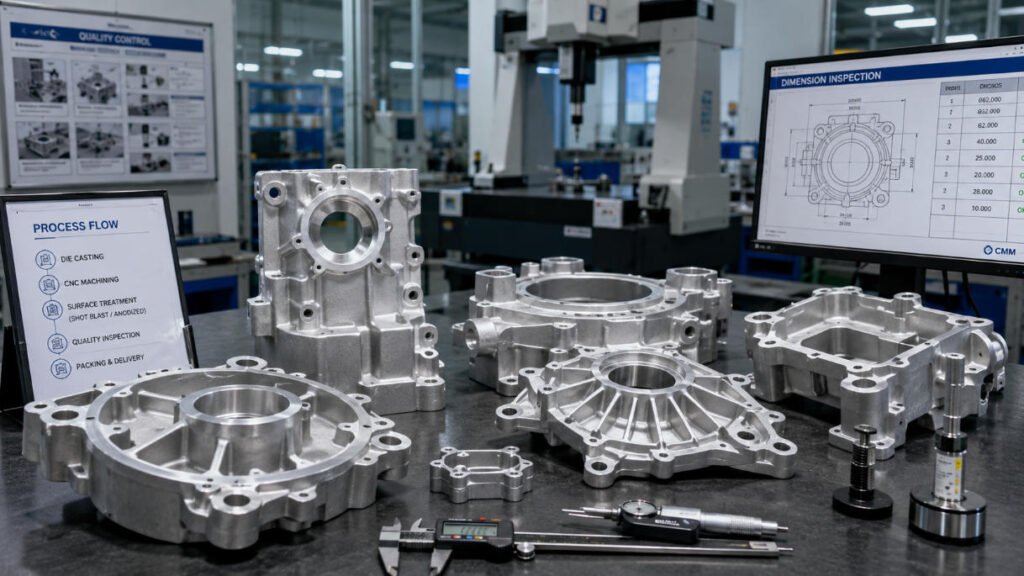
Die Casting → CNC Machining → Surface Finishing → Inspection
This approach combines production efficiency with precision requirements.
How to Choose the Right Die Casting Manufacturer
Choosing a die casting supplier is not only about finding a company with casting machines.
OEM buyers should evaluate:
Tooling Capability
A reliable supplier should understand:
- Mold design
- Tool maintenance
- Production durability
DFM Engineering Support
A capable supplier should help identify:
- Casting risks
- Wall thickness issues
- Metal flow problems
- Potential defects
Post-Machining Capability
Many die cast parts require additional operations:
- CNC machining
- Drilling
- Tapping
- Precision finishing
A supplier with integrated capabilities can simplify project management.
Inspection Capability
Quality control may include:
- Dimensional inspection
- CMM measurement
- Material verification
- Visual inspection
Export Experience
For global OEM customers, experience with:
- Packaging
- Documentation
- International shipping
is also important.
How FSD Precision Supports Die Casting Projects
FSD Precision provides OEM customers with complete die casting solutions from engineering review to finished parts.
Our support includes:
- Die casting project evaluation
- Aluminum and zinc die cast parts
- Tooling coordination
- CNC post-machining
- Surface finishing
- Quality inspection
- Export-ready delivery
We help customers evaluate:
- Part design
- Material selection
- Production volume
- Tolerance requirements
- Application environment
Our goal is to create a reliable manufacturing process, not simply produce cast parts.
FAQ
What materials are commonly used in die casting?
The most common die casting materials include aluminum, zinc and magnesium alloys. The best choice depends on strength, weight, corrosion resistance and application requirements.
Is die casting suitable for prototypes?
Traditional die casting requires tooling investment, so it is usually more suitable for medium and high-volume production. CNC machining or alternative processes may be better for prototypes.
Do die cast parts require CNC machining?
Some parts can be used directly after casting, but many OEM components require CNC machining for:
- Precision holes
- Threads
- Assembly surfaces
- Tight tolerance areas
How do I choose between aluminum and zinc die casting?
The choice depends on:
- Part size
- Strength requirements
- Surface finish
- Production volume
- Cost requirements
What information is needed for a die casting quote?
A complete RFQ should include:
- 3D CAD files
- 2D drawings
- Material requirements
- Quantity
- Surface finish
- Critical tolerances
- Annual production volume
Before starting a project, you can also review our RFQ checklist.
Conclusion
Die casting is an efficient manufacturing solution for producing repeatable metal components at medium and high production volumes.
Successful die casting requires more than casting equipment. Tooling design, DFM review, material selection, CNC post-machining and quality control all influence final part performance.
FSD Precision helps OEM customers develop complete die casting solutions from initial engineering review through production and final delivery.
Ready to start your custom die casting project?
Send your CAD files and project requirements to FSD Precision for engineering review and quotation.
Need help sourcing custom OEM parts?
Send drawings, samples, part numbers, material requirements, quantity, and application details for engineering review.