
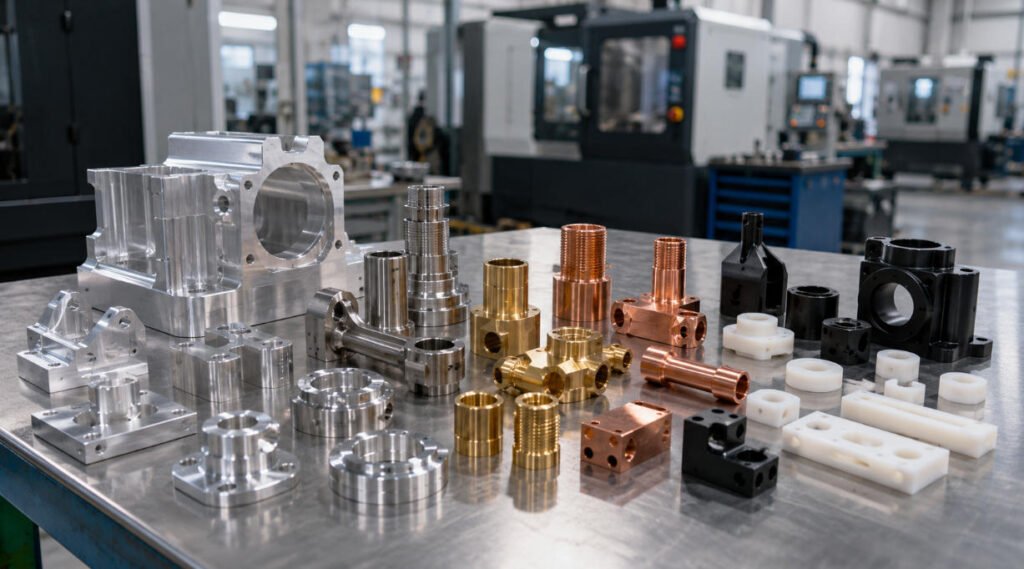
Choosing the right CNC machining material is not only about material price. For OEM metal and plastic parts, buyers also need to consider strength, weight, corrosion resistance, wear resistance, machinability, tolerance stability, surface finish, and the final working environment.
FSD Precision provides CNC machining services for custom OEM parts made from aluminum, stainless steel, carbon steel, brass, copper, POM, PEEK, nylon, ABS, PC and other engineering materials. We help buyers review drawings, confirm material options, and evaluate whether a material is suitable before quotation and production.
Why Material Selection Matters in CNC Machining
A CNC machined part may look simple on the drawing, but the material choice can change cost, lead time, tolerance control, surface finish, and long-term performance.
For example, aluminum is easy to machine and suitable for lightweight parts. Stainless steel provides better strength and corrosion resistance, but usually requires more machining time. Engineering plastics such as POM and PEEK are useful for low-friction or lightweight components, but they need proper machining control because plastics may deform more easily than metals.
Before sending an RFQ, buyers should confirm whether the material is selected for function, appearance, cost, availability, or operating conditions.
You can also read our earlier guide: Custom CNC Machining Services in China.
Common CNC Machining Metals
Metal materials are widely used in CNC machining because they offer strength, durability, heat resistance, conductivity, and reliable mechanical performance.
| Material | Key Features | Common Applications |
|---|---|---|
| Aluminum 6061 | Lightweight, good machinability, good anodizing result | Housings, brackets, plates, heat sinks |
| Aluminum 7075 | Higher strength than 6061 | Fixtures, structural parts, high-strength components |
| Stainless Steel 304 | Good corrosion resistance, widely used | Shafts, fittings, brackets, equipment parts |
| Stainless Steel 316 | Better corrosion resistance than 304 | Marine, chemical, medical device and outdoor parts |
| Carbon Steel | Strong, cost-effective, can be coated or plated | Mechanical parts, mounts, structural components |
| Brass | Good machinability and corrosion resistance | Fittings, threaded parts, bushings, connectors |
| Copper | Excellent electrical and thermal conductivity | Conductive parts, terminals, heat-transfer parts |
Aluminum 6061 is one of the most common CNC machining materials because it balances cost, machinability, strength, and surface finish. It is often used for equipment housings, brackets, plates, and parts requiring anodizing.
Stainless steel is a better choice when the part needs higher strength or corrosion resistance. Buyers should also understand that stainless steel is usually more difficult to machine than aluminum, which may affect cost and lead time.
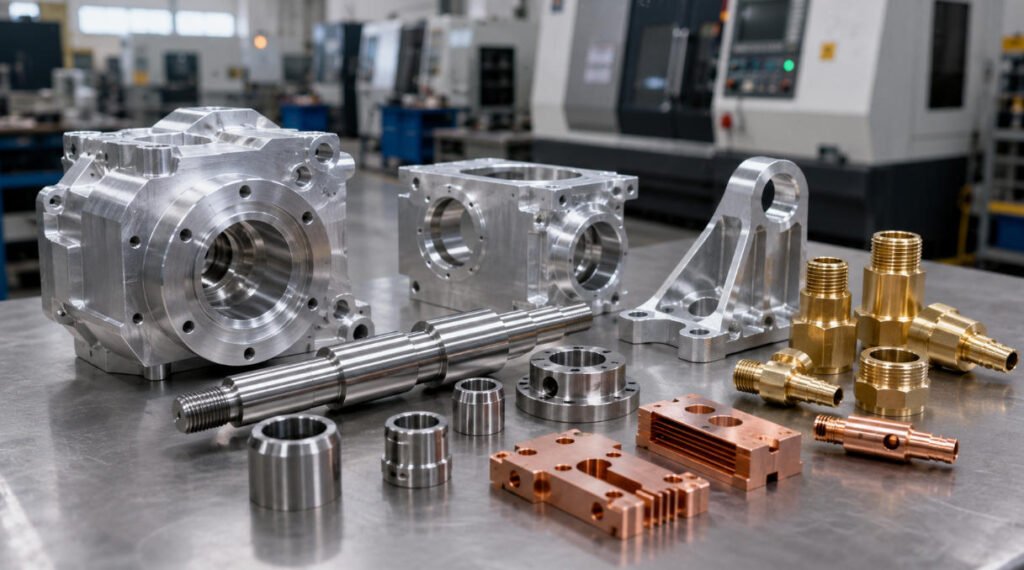
Brass and copper are often selected for fittings, conductive parts, terminals, and threaded components. For copper parts, the structure, tolerance, and surface finish should be reviewed carefully before production.
Common CNC Machining Plastics
Engineering plastics are often used when buyers need lightweight parts, electrical insulation, low friction, chemical resistance, or reduced noise during operation.
| Plastic Material | Key Features | Common Applications |
|---|---|---|
| POM / Delrin | Low friction, good wear resistance, stable machining | Rollers, guides, bushings, sliding parts |
| PEEK | High-performance plastic, heat and chemical resistance | High-end equipment parts, demanding applications |
| Nylon | Tough, wear-resistant, lightweight | Gears, rollers, spacers, wear parts |
| ABS | Easy to machine, useful for prototypes | Functional prototypes, covers, plastic housings |
| PC | Good impact resistance | Covers, guards, functional plastic parts |
| PTFE | Very low friction, chemical resistance | Seals, sliding parts, insulation components |
POM is a practical choice for wear parts, guides, rollers, and sliding components. It machines well and offers good dimensional stability for many industrial applications.
PEEK is more expensive, but it is selected when the application requires higher heat resistance, chemical resistance, or long-term mechanical performance. For cost-sensitive projects, buyers should confirm whether PEEK is truly required or whether another engineering plastic can meet the application.
For plastic CNC machined parts, tolerance control needs special attention. Proper fixture design, cutting parameters, cooling method, wall thickness review, and inspection planning can help reduce deformation risk.
How to Choose the Right CNC Machining Material
There is no single best CNC machining material. The best choice depends on how the part will be used, the working environment, strength requirements, appearance needs, cost target, and surface finish.
| Requirement | Recommended Material Options |
|---|---|
| Lightweight structure | Aluminum 6061, Aluminum 6082 |
| Higher strength lightweight part | Aluminum 7075 |
| Corrosion resistance | Stainless Steel 304 / 316, anodized aluminum |
| Electrical conductivity | Copper, brass |
| Heat dissipation | Aluminum, copper |
| Low friction or wear resistance | POM, nylon, PTFE |
| High-performance plastic part | PEEK |
| Cost-sensitive metal part | Aluminum 6061, carbon steel |
| Good appearance after finishing | Anodized aluminum, brass, polished stainless steel |
For many OEM projects, the drawing may already specify a material, but there may still be room for alternatives. A reliable supplier should not change the material without approval, but can suggest options when the original material is expensive, difficult to source, or not necessary for the actual application.
For flat surfaces, pockets, slots, holes, and multi-side features, CNC milling is commonly used. For round parts such as shafts, sleeves, pins, bushings, and threaded components, CNC turning is usually more suitable.
Surface Finish by Material
Surface finish should be considered together with material selection. A material may machine well, but the final part may still need anodizing, plating, polishing, painting, or coating to meet appearance, corrosion, or wear requirements.
| Material | Common Surface Finish Options |
|---|---|
| Aluminum | Anodizing, hard anodizing, sandblasting, painting, powder coating |
| Stainless Steel | Polishing, passivation, brushing |
| Carbon Steel | Zinc plating, nickel plating, black oxide, painting, powder coating |
| Brass | Polishing, nickel plating, natural finish |
| Copper | Polishing, plating, anti-oxidation treatment |
| Engineering Plastics | As-machined finish, polishing depending on material |
Surface finish may affect final dimensions, especially on tight-fit areas, threaded holes, sealing surfaces, and bearing positions. These areas should be marked clearly on the drawing before production.
FSD Precision can also coordinate surface finishing services after CNC machining, including anodizing, plating, polishing, painting, powder coating and other common finishing options.
CNC Machining Material RFQ Checklist
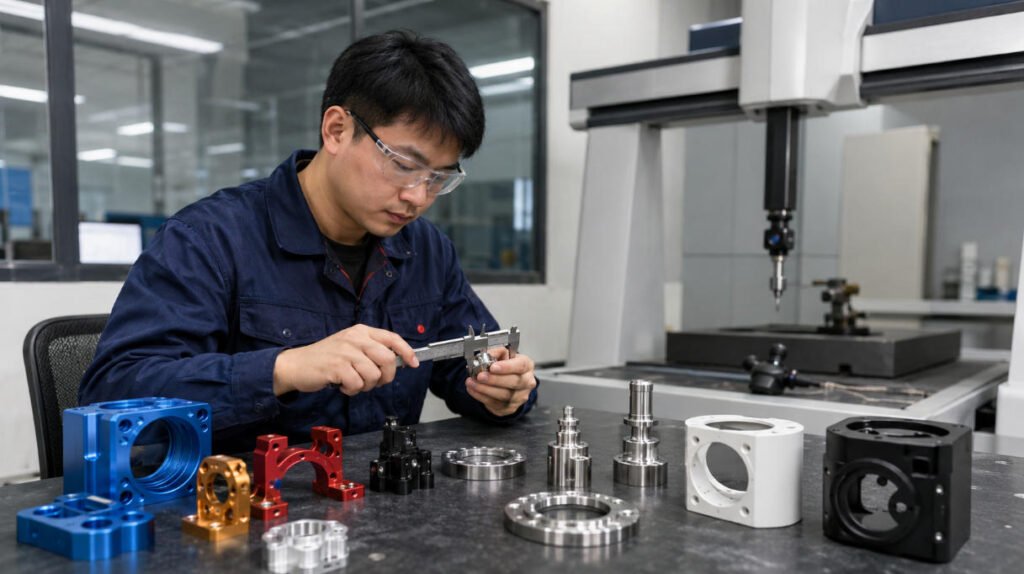
To receive a more accurate quotation, buyers should provide clear material and project information during RFQ.
| RFQ Information | Why It Helps |
|---|---|
| 2D drawing | Shows tolerances, surface finish, threads, and notes |
| 3D file | Helps review geometry and machining method |
| Material grade | Confirms cost, availability, strength, and finish |
| Quantity | Affects prototype, low-volume, or production pricing |
| Surface finish | Impacts process route and final dimensions |
| Application | Helps evaluate whether the material is suitable |
| Critical dimensions | Helps plan machining and inspection |
| Alternative material allowed or not | Helps reduce cost or lead time when possible |
If the material is not confirmed, buyers can send the drawing and application details first. FSD Precision can review the project and discuss suitable material options before quotation.
Need help choosing the right CNC machining material?
Contact FSD Precision and send your drawings for review.
Why Work With FSD Precision?
FSD Precision is a China-based OEM manufacturing partner supporting custom metal and plastic parts. For CNC machining projects, we support aluminum CNC parts, stainless steel parts, brass and copper parts, engineering plastic parts, CNC milled components, CNC turned parts, prototypes, low-volume production, repeat production, surface finishing, inspection, packaging, and export delivery.
Instead of only quoting based on material name and quantity, we review material, tolerance, surface finish, structure, quantity, and application together. This helps reduce misunderstanding before production and improves the chance of stable delivery.
FAQ
What is the best material for CNC machining?
There is no single best material for all CNC machining projects. Aluminum 6061 is a common and cost-effective choice, stainless steel is suitable for strength and corrosion resistance, brass and copper are used for conductive parts, and engineering plastics are useful for lightweight or low-friction components.
Is aluminum good for CNC machined parts?
Yes. Aluminum is widely used for CNC machined parts because it is lightweight, easy to machine, cost-effective, and suitable for many surface finishes such as anodizing and powder coating.
What stainless steel is commonly used for CNC machining?
Stainless Steel 304 and 316 are commonly used. 304 is practical for many industrial parts, while 316 is better when stronger corrosion resistance is required.
Can plastics be CNC machined?
Yes. POM, PEEK, nylon, ABS, PC, PTFE and other engineering plastics can be CNC machined. Plastic parts need proper design and machining control because they may deform more easily than metal parts.
How do I choose between aluminum and stainless steel?
Choose aluminum when lightweight, machinability, heat dissipation, and anodizing are important. Choose stainless steel when higher strength, corrosion resistance, or long-term durability is more important.
Conclusion
Material selection is one of the most important decisions in a CNC machining project. The right material can improve performance, reduce cost, simplify machining, and support stable production. The wrong material may increase cost, delay production, or create problems during assembly.
If you are sourcing CNC machined metal or plastic parts, FSD Precision can help review your drawings, material requirements, tolerance notes, surface finish, and application details before quotation.
Send your CNC machining drawings to FSD Precision for material review and quotation.
Need help sourcing custom OEM parts?
Send drawings, samples, part numbers, material requirements, quantity, and application details for engineering review.