
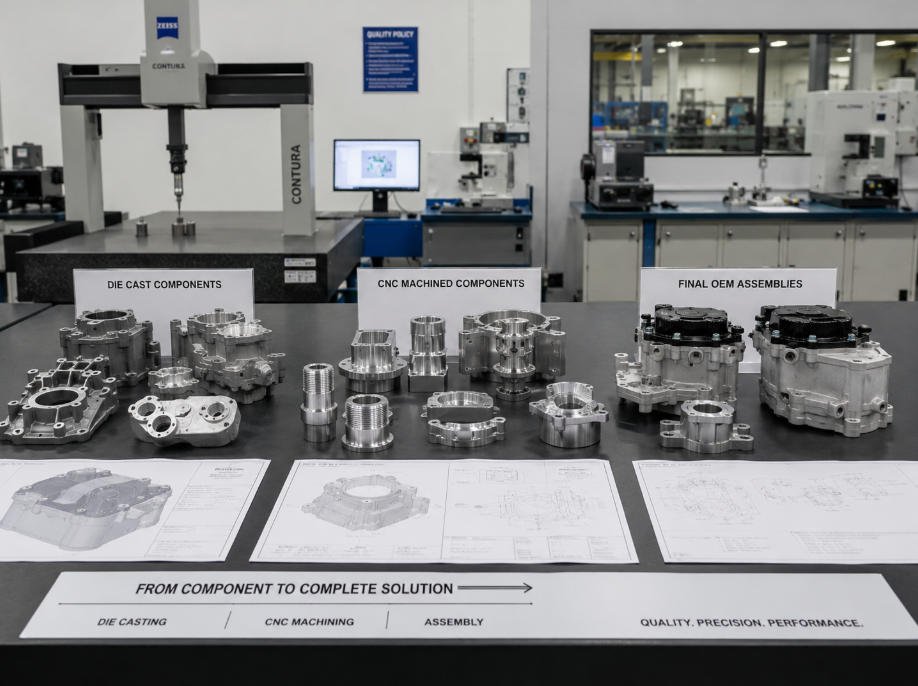
Die casting and CNC machining are two widely used manufacturing processes for OEM metal components, but they are designed for different production requirements.
Die casting is typically the preferred solution for medium and high-volume production where tooling investment can be distributed across a large number of parts, reducing the piece cost over time.
CNC machining is commonly used for prototypes, low-volume production, design validation and components requiring tighter dimensional control or frequent design changes.
The right manufacturing process depends on:
- Production volume
- Part geometry
- Material requirements
- Tolerance requirements
- Surface finish expectations
- Total project cost
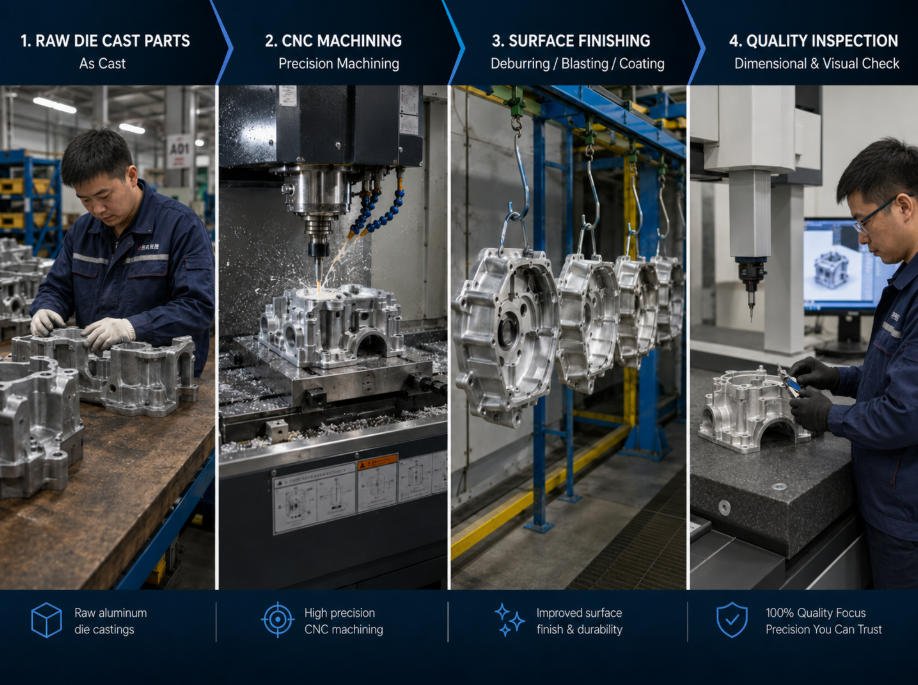
For many OEM projects, the best solution is not choosing between die casting and CNC machining, but combining both:
Die Casting → CNC Post-Machining → Surface Finishing → Inspection
At FSD Precision, we help customers evaluate the most efficient manufacturing route based on engineering requirements, production goals and cost objectives.
Learn more about our Custom Die Casting Services.
Die Casting vs CNC Machining: Key Differences
The main difference between these two processes is how the part is created.
Die casting uses a reusable steel mold to create parts through high-pressure metal injection.
CNC machining removes material from a solid workpiece using computer-controlled cutting tools.
Each process has different advantages depending on the application.
| Feature | Die Casting | CNC Machining |
|---|---|---|
| Best production stage | Medium/high volume | Prototype and low volume |
| Tooling requirement | Requires steel mold | No dedicated mold |
| Initial investment | Higher upfront tooling cost | Lower startup cost |
| Piece cost at scale | Lower | Higher |
| Design flexibility | Limited after tooling | Highly flexible |
| Material efficiency | Near-net-shape process | More material removal |
| Production speed | Faster for repeat production | Depends on machining time |
| Best application | Stable production parts | Custom precision components |
When Should You Choose Die Casting?
Die casting is usually the better option when your project requires:
1. Medium or High Production Volume
The biggest advantage of die casting is production efficiency.
Although tooling requires an initial investment, the cost can be distributed across thousands of parts.
Typical applications include:
- Automotive housings
- Electronics enclosures
- Industrial components
- Structural brackets
2. Complex Near-Net-Shape Components
Die casting is suitable for parts requiring:
- Thin walls
- Integrated ribs
- Complex housings
- Lightweight structures
Because the mold creates most of the part geometry, less material removal is required compared with machining from solid stock.
3. Stable Product Design
Die casting works best when:
- CAD design is finalized
- Engineering changes are limited
- Long-term production is expected
Frequent design changes after tooling production can increase modification costs.
For design optimization before tooling, review our:
When Should You Choose CNC Machining?
CNC machining is often the better choice when flexibility and precision are the priority.
1. Prototype and Low-Volume Production
CNC machining is ideal for:
- Functional prototypes
- Engineering validation
- Market testing
- Small production batches
Because no dedicated mold is required, design changes can be implemented faster.
2. Tight Dimensional Requirements
CNC machining is commonly used for:
- Bearing bores
- Precision holes
- Threads
- Assembly surfaces
- Critical mating features
For components requiring strict dimensional control, CNC machining provides greater flexibility.
Learn more about our:
3. Frequent Design Changes
For products still under development, CNC machining allows engineers to update CAD models without modifying production tooling.
The Hybrid Solution: Die Casting + CNC Machining
Many successful OEM production programs use both processes together.
The typical workflow:
Phase 1: Die Casting
Create the near-net-shape component.
Advantages:
- Fast production cycles
- Lower material waste
- Consistent repeatability
Phase 2: CNC Post-Machining
Machine critical functional areas:
- Bearing seats
- Threads
- Precision holes
- Sealing surfaces
Phase 3: Surface Finishing
Improve:
- Appearance
- Corrosion resistance
- Functional performance
Explore our:
Phase 4: Inspection
Verify:
- Critical dimensions
- Assembly requirements
- Quality consistency
This hybrid approach allows OEM customers to achieve production efficiency while maintaining precision requirements.
Cost Analysis: Understanding the Break-Even Point
The decision between die casting and CNC machining is often determined by total project cost.
Die Casting Cost Structure
Main cost factors:
- Mold tooling
- Material
- Production volume
- Surface finishing
Die casting requires higher initial investment, but piece cost decreases as production volume increases.
CNC Machining Cost Structure
Main cost factors:
- Machine time
- Programming
- Material removal
- Labor
CNC machining has lower startup costs, but unit cost remains closely related to processing time.
Finding the Break-Even Threshold
Below the break-even point:
CNC machining may provide the lower total project cost because no mold investment is required.
Above the break-even point:
Die casting often becomes more economical because lower piece costs offset the tooling investment.
The actual break-even point depends on:
- Part size
- Complexity
- Material
- Annual production volume
- Tooling requirements
How FSD Precision Helps OEM Customers Choose the Right Process
FSD Precision does not force every project into a single manufacturing method.
Our engineering team evaluates:
- Part geometry
- Production volume
- Material requirements
- Tolerance requirements
- Surface finish needs
Then we recommend the most suitable solution:
- Die casting
- CNC machining
- Hybrid manufacturing
Why Choose FSD Precision?
FSD Precision provides integrated OEM manufacturing solutions from engineering review to final delivery.
Our capabilities include:
- Die casting
- CNC machining
- Surface finishing
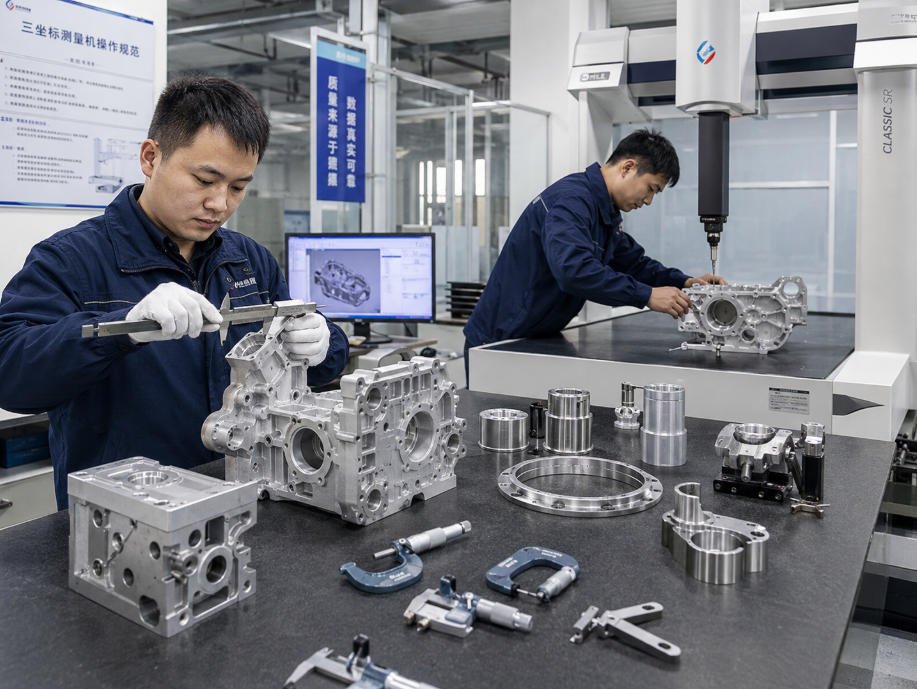
- Quality inspection
- Export support
Our manufacturing process includes:
Design Review
↓
Process Selection
↓
Tooling / Programming
↓
Production
↓
Inspection
↓
Delivery
By combining multiple manufacturing technologies, we help customers reduce supply chain complexity and improve production reliability.
FAQ
Is die casting always cheaper than CNC machining?
No.
Die casting is usually more economical when production volume is high enough to justify tooling investment.
For prototypes and low-volume projects, CNC machining is often the better option.
When should I choose CNC machining instead of die casting?
CNC machining is preferred when you need:
- Low-volume production
- Frequent design changes
- Tight dimensional control
- Flexible manufacturing
Can die cast parts be CNC machined?
Yes.
Many die cast components require CNC machining for:
- Precision holes
- Threads
- Bearing areas
- Assembly surfaces
How many parts are needed to justify die casting tooling?
The break-even point depends on:
- Tooling cost
- Part complexity
- Material
- Annual production volume
Each project requires an engineering cost evaluation.
Does FSD Precision provide both die casting and CNC machining?
Yes.
FSD Precision supports OEM customers with:
- Die casting
- CNC machining
- Surface finishing
- Inspection
- Export delivery
Conclusion
Die casting and CNC machining are not competing processes. They are complementary manufacturing solutions designed for different production requirements.
CNC machining provides flexibility and precision for prototypes and low-volume projects.
High-pressure die casting provides production efficiency and lower piece costs for stable, high-volume programs.
For many OEM applications, the best solution combines both technologies through a hybrid manufacturing workflow.
FSD Precision helps customers select the right manufacturing approach and deliver finished metal components through:
- Die casting
- CNC machining
- Surface finishing
- Quality inspection
Ready to choose the right manufacturing process for your project?
Send your CAD files and requirements to FSD Precision for engineering evaluation and quotation.
Need help sourcing custom OEM parts?
Send drawings, samples, part numbers, material requirements, quantity, and application details for engineering review.