
Trust & Quality Assurance
✓ ISO 9001:2015 Certified OEM Manufacturing Partner
✓ DFM Review Before Tooling Investment
✓ Integrated Die Casting + CNC Machining Capability
✓ Transparent Manufacturing Cost Evaluation
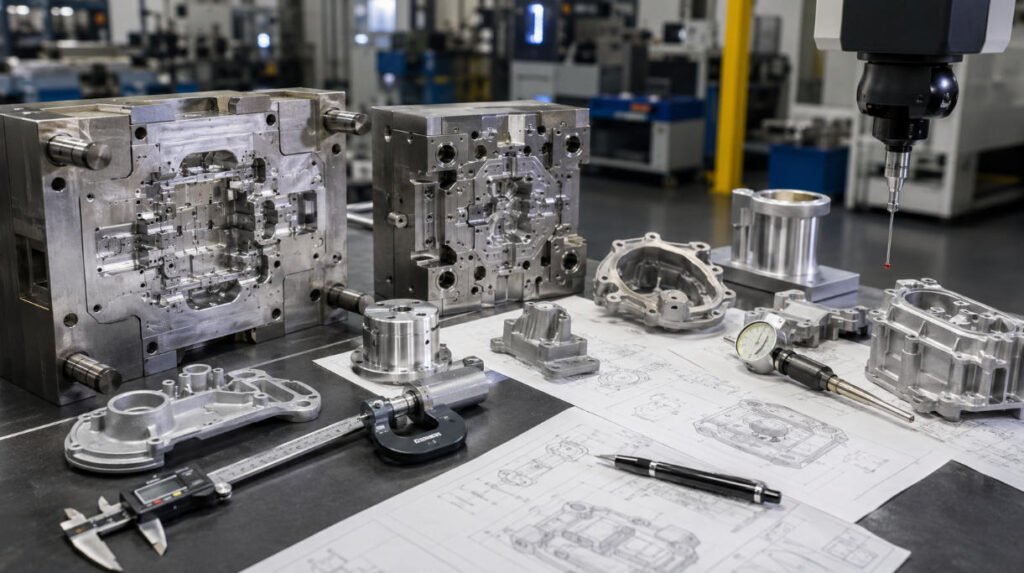
Direct Answer: What Determines Die Casting Cost?
Aluminum and zinc die casting costs are mainly influenced by five engineering and production factors:
- Tooling Investment
Mold design, cavity configuration, slides, cooling systems and tooling requirements. - Material Selection
Alloy type, part weight, material efficiency and production requirements. - Production Volume
How tooling investment is distributed across total production quantity. - Part Complexity
Geometry, undercuts, tolerances and machining requirements. - Secondary Operations
CNC machining, surface finishing and quality inspection.
Unlike CNC machining, die casting requires an upfront tooling investment.
However, once the mold is completed, faster production cycles and repeatability can significantly reduce piece cost for medium and high-volume programs.
The lowest initial quotation does not always represent the lowest total manufacturing cost.
OEM buyers should evaluate:
- Tooling amortization
- Piece price
- Scrap rate
- CNC machining requirements
- Surface finishing
- Quality documentation
- Logistics considerations
FSD Precision helps OEM customers evaluate total manufacturing cost through engineering review, tooling analysis and integrated production solutions.
Explore our:
Understanding Total Cost of Ownership (TCO) in Die Casting
Many buyers focus only on the initial mold price.
However, the real cost of a die casting project includes the complete production lifecycle.
A complete TCO evaluation includes:
| Cost Element | Impact |
|---|---|
| Tooling Investment | Initial mold development and maintenance |
| Material Cost | Alloy selection and part weight |
| Production Efficiency | Cycle time and repeatability |
| CNC Machining | Precision features after casting |
| Surface Finishing | Appearance and protection requirements |
| Quality Requirements | Inspection and documentation |
| Logistics | Packaging and supply chain costs |
A supplier with the lowest tooling price may not always provide the lowest total project cost.
Engineering optimization before production often creates greater long-term savings.
Major Die Casting Cost Drivers
Cost Breakdown Overview
| Cost Factor | Main Influences | Cost Impact |
|---|---|---|
| Tooling | Mold structure, cavities, slides and steel selection | Higher initial investment but lower piece cost at scale |
| Material | Aluminum, zinc or magnesium alloys | Direct production cost impact |
| Volume | Annual demand and production frequency | Determines tooling amortization |
| Complexity | Geometry, tolerances and features | Affects tooling and machining requirements |
| Secondary Processing | CNC, finishing and inspection | Adds functional value |
1. Die Casting Tooling Costs
Tooling is usually the largest upfront investment in a die casting project.
A production mold includes:
- Mold design
- Tool steel selection
- Cavities
- Slides and inserts
- Cooling channels
- Ejection system
Factors Affecting Tooling Cost
Part Size and Complexity
Complex parts may require:
- Additional slides
- Special inserts
- More complicated cooling systems
These features increase tooling complexity and development cost.
Mold Cavity Design
Production requirements influence mold configuration.
Single-Cavity Mold
Suitable for:
- Pilot production
- Lower volume programs
- Large structural parts
Multi-Cavity Mold
Suitable for:
- Stable production programs
- Higher output requirements
- Lower unit cost targets
Tooling Modification Risk
Late design changes after mold production begins can significantly increase project cost.
Common causes:
- Unclear design requirements
- Missing tolerance information
- Product changes after tooling
This is why early DFM review is critical before tool steel is machined.
2. Material Selection and Cost Impact
Material selection directly affects:
- Raw material cost
- Casting performance
- Cycle efficiency
- Surface finishing options
Common die casting materials include:
- Aluminum
- Zinc
- Magnesium
Aluminum Die Casting
Aluminum is commonly selected for:
- Lightweight components
- Structural parts
- Thermal management applications
Common alloys:
- A380
- ADC12
- A360
Learn more:
Zinc Die Casting
Zinc is commonly used for:
- Small precision components
- Thin-wall parts
- Decorative applications
Advantages:
- Excellent fluidity
- Good dimensional stability
- Strong finishing capability
Compare materials:
3. Production Volume and Break-Even Analysis
Production volume is one of the most important factors when selecting between die casting and CNC machining.
Low Volume Production
For prototypes and small production runs:
CNC machining may provide a lower total project cost because no dedicated mold investment is required.
Medium Volume Production
Die casting becomes increasingly competitive because tooling costs can be distributed across more parts.
High Volume Production
For long-term programs, die casting provides:
- Faster production
- Lower piece cost
- Better repeatability
The actual break-even point depends on:
- Tooling cost
- Part complexity
- Machining requirements
- Annual production volume
Die Casting vs CNC Machining Cost Comparison
| Factor | Die Casting | CNC Machining |
|---|---|---|
| Initial investment | Higher tooling investment | Lower startup cost |
| Best application | Medium/high volume | Prototype and low volume |
| Piece cost | Lower at scale | Higher for large quantities |
| Material efficiency | Near-net-shape process | More material removal |
| Design changes | More difficult after tooling | Easier CAD updates |
For detailed comparison:
4. Part Complexity and DFM Cost Impact
Part geometry directly influences die casting cost.
Cost increases may come from:
- Complex undercuts
- Side-action slides
- Tight tolerances
- Difficult machining areas
Design Optimization Reduces Cost
Early DFM review helps identify:
- Unnecessary complexity
- Poor wall thickness transitions
- Difficult tooling areas
- Additional machining requirements
Review our:
5. Secondary Processing and Quality Costs
Die casting produces efficient near-net-shape components.
However, many OEM parts require additional processing.
CNC Post-Machining
Required for:
- Precision holes
- Threads
- Bearing seats
- Sealing surfaces
FSD Precision combines:
with die casting production.
Surface Finishing
Common requirements include:
- Powder coating
- Painting
- Sand blasting
- Plating
Defining finishing requirements early prevents unexpected quotation changes.
Quality Requirements Impact Cost
Some OEM projects require additional quality controls:
- CMM inspection
- Material verification
- Leak testing
- Quality reports
- First Article Inspection (FAI)
Higher inspection requirements increase cost but improve production reliability.
For quality considerations, review:
Die Casting Defects: Causes, Prevention Methods & Quality Control
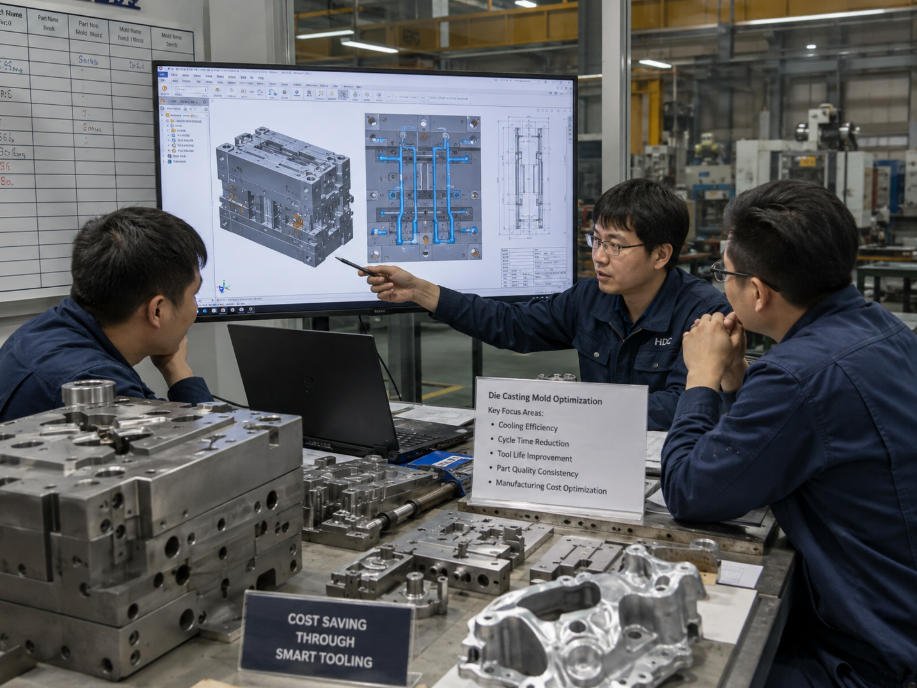
How OEM Buyers Can Reduce Die Casting Costs
Reducing cost does not mean choosing the cheapest supplier.
The best cost strategy comes from improving the entire manufacturing process.
1. Optimize Design Before Tooling
Early DFM review helps:
- Reduce mold modifications
- Improve manufacturability
- Prevent production risks
2. Select the Correct Manufacturing Process
Choose based on:
- Production volume
- Precision requirements
- Product lifecycle
3. Prepare Complete Technical Information
A complete RFQ package improves quotation accuracy.
Include:
- 3D CAD files
- 2D drawings
- Material requirements
- Production quantity
- Surface finish specifications
Review:
How FSD Precision Helps Control Die Casting Costs
FSD Precision helps OEM customers optimize total manufacturing cost through:
Engineering Review
Evaluating:
- Part design
- Material selection
- Manufacturing feasibility
Tooling Optimization
Improving:
- Mold strategy
- Production efficiency
- Long-term tooling performance
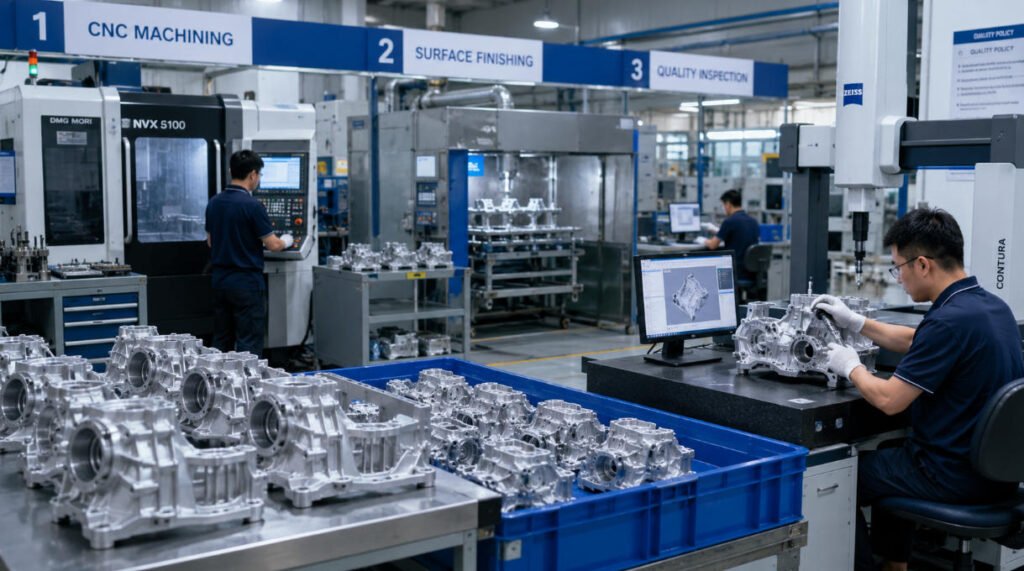
Integrated Manufacturing
Combining:
Die Casting
↓
CNC Machining
↓
Surface Finishing
↓
Quality Inspection
This reduces supplier coordination, improves quality control and helps optimize total landed cost.
FAQ
How much does die casting cost?
Die casting cost depends on:
- Tooling complexity
- Material selection
- Part dimensions
- Production volume
- Secondary processing requirements
A detailed quotation requires CAD files and engineering specifications.
How much does a die casting mold cost?
Tooling costs vary depending on:
- Part complexity
- Mold structure
- Production requirements
- Expected tool performance
Each project requires engineering evaluation.
Is die casting cheaper than CNC machining?
For prototypes and low-volume production, CNC machining may be more economical.
For medium and high-volume production, die casting often provides lower piece costs.
Why do die casting quotes vary between suppliers?
Quotes may vary because suppliers use different:
- Tooling strategies
- Materials
- Production processes
- Machining plans
- Quality requirements
The lowest quotation is not always the lowest total project cost.
How can OEM buyers reduce die casting costs?
OEM buyers can reduce costs by:
- Optimizing designs early
- Selecting suitable materials
- Providing complete RFQ information
- Working with an integrated manufacturing partner
Conclusion
Die casting cost is influenced by much more than raw material price.
Tooling investment, material selection, production volume, part complexity, secondary machining and quality requirements all affect total project economics.
The most effective way to control die casting cost is making the right engineering decisions before production begins.
FSD Precision helps OEM customers optimize die casting projects through:
- DFM engineering review
- Tooling coordination
- Die casting production
- CNC post-machining
- Surface finishing
- Quality inspection
Ready to understand your die casting project cost?
Upload your 3D CAD files and engineering drawings for a professional manufacturing evaluation.
👉 Get Your Die Casting Cost Evaluation from FSD Precision
Need help sourcing custom OEM parts?
Send drawings, samples, part numbers, material requirements, quantity, and application details for engineering review.